
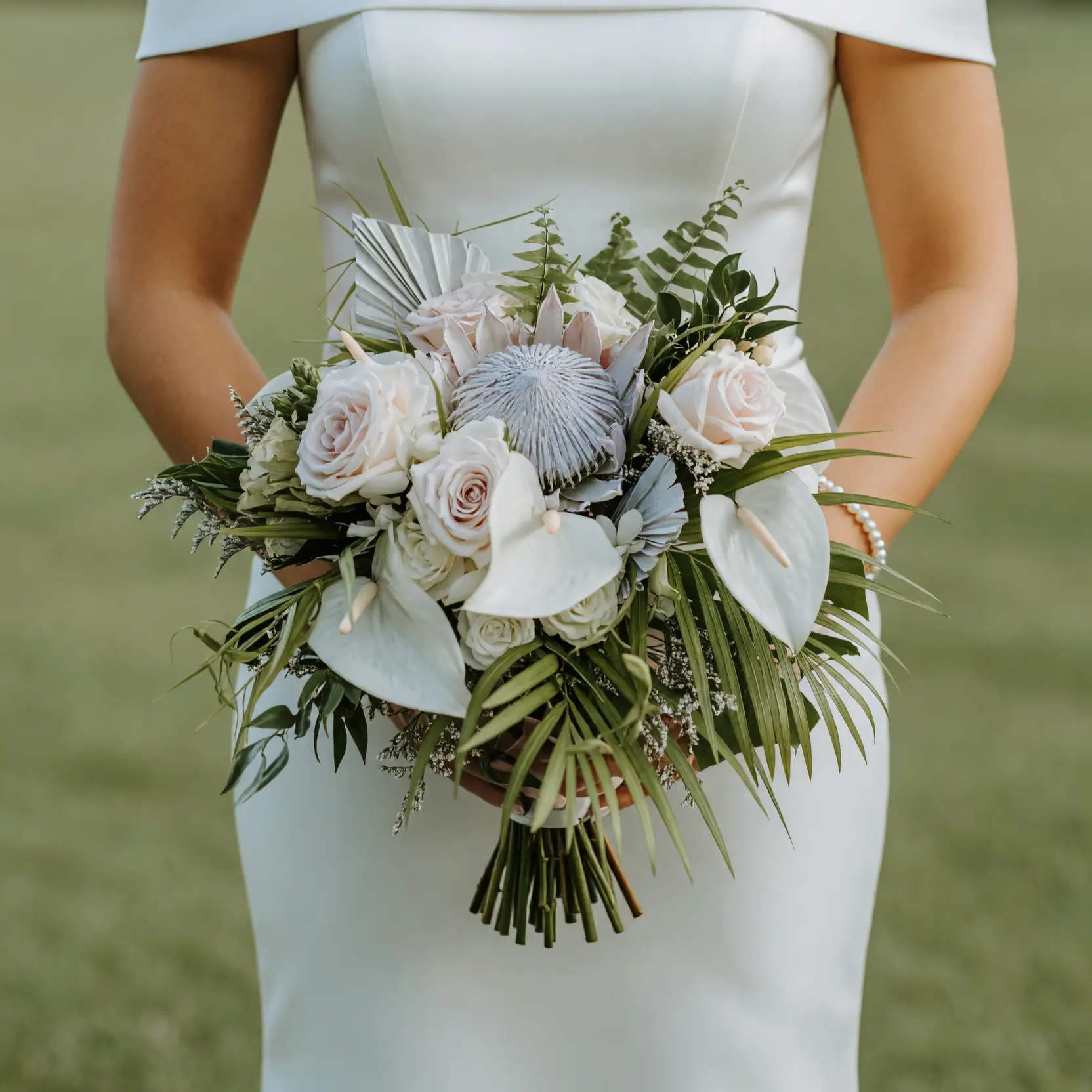
Beach Wedding Bouquets can achieve dramatic tropical elegance through sculptural silver protea, luminous white flowers, and abundant palm foliage. This bold hand-tied arrangement combines a large silver-toned protea, ivory roses, white anthuriums, miniature spray roses, pale hydrangea, delicate filler flowers, metallic botanical accents, fern fronds, and layered tropical greenery. Its white, silver, sage, and deep green palette feels contemporary, luxurious, and perfectly suited to a sophisticated coastal celebration.
A magnificent king protea forms the bouquet’s commanding central focal point. Its rounded silvery centre is surrounded by pointed bracts that open like a botanical crown. The cool grey-white coloring gives the flower a distinctive sculptural presence without disrupting the restrained bridal palette.
Fine lines radiate across the protea’s centre, creating intricate natural texture. This unusual surface contrasts beautifully with the smooth anthurium petals and layered roses. The flower will be especially striking in close-up photographs, where every silvery detail can be appreciated.
The protea is positioned near the upper middle of the bouquet, where it anchors the entire composition. Large flowers and leaves surround it, but its unique shape remains clearly visible. Its substantial scale gives the arrangement confidence and contemporary destination-wedding character.
Ivory roses soften the protea and bring traditional bridal romance. Their layered petals form elegant spiral shapes throughout the upper, side, and central sections. Several blooms appear fully open, while smaller roses and buds add depth.
The roses have a warm white or very pale blush tone. This subtle warmth prevents the arrangement from appearing cold despite the silver accents. It also creates a gentle contrast against the bride’s white gown.
A large rose on the left balances another prominent bloom on the right. Additional roses appear close to the protea and lower anthuriums, distributing their classic form across the bouquet.
Miniature spray roses fill spaces between the larger flowers. Their small rosette shapes introduce delicate detail and reinforce the arrangement’s romantic quality. Some blooms remain tightly gathered while others are partially open.
Pale hydrangea creates soft cloudlike volume beneath the roses and protea. Its many small petals fill the central spaces without competing against the stronger flower forms. The creamy color also connects the roses to the white anthuriums.
White anthuriums provide broad sculptural accents around the lower and right portions. Their heart-shaped petals have a smooth, gently rippled surface and long cream spadices. Their tropical identity makes them a natural choice for a coastal or resort wedding.
One anthurium extends prominently from the right side, widening the silhouette. Another opens near the lower centre, while a third appears toward the left. Their repeated shapes create balance and guide the eye around the bouquet.
The anthuriums’ luminous surfaces contrast with the finely textured protea. Their broad petals provide visual calm among the many narrow palm leaves and filler stems. Their white coloring preserves the arrangement’s refined monochromatic floral palette.
Tiny white filler flowers are scattered between the roses, hydrangea, anthuriums, and greenery. Their airy clusters create a lace-like texture and brighten darker spaces. The small blossoms also soften transitions between the flowers and foliage.
Some filler stems extend beyond the central cluster, making the arrangement feel freshly gathered and organic. Their delicate scale ensures that they add texture without distracting from the protea.
Silver-toned palm accents appear behind the flowers. Folded fan-shaped leaves create geometric texture and reinforce the bouquet’s modern styling. Their metallic grey color reflects the protea and adds an elegant destination-inspired detail.
One folded palm leaf rises on the upper left, creating height and a distinctive architectural line. A smaller silver fan appears near the lower right, repeating the material and balancing the composition.
These pale palm elements give the bouquet a contemporary tropical character. Their structured folds contrast with the natural curves of roses, anthuriums, and fern fronds. The result feels polished and fashion-forward.
Fresh palm leaves form a dramatic green frame. Long narrow leaflets extend across the lower right and side sections, creating width and movement. Their deep green color provides strong contrast against the white and silver flowers.
Some palm fronds curve downward, giving the bouquet a loose cascading edge. Others rise behind the protea and roses, contributing height. Their varied directions create an energetic yet balanced silhouette.
Fern fronds appear throughout the upper and side sections. Their fine divided leaves add fresh botanical texture and soften the stronger palm lines. Some ferns curve outward, while others remain closer to the flowers.
Narrow glossy leaves fill spaces among the palm and fern foliage. Their shapes provide a transition from broad anthuriums to fine tropical greenery. The layered leaves create depth without obscuring the flowers.
Pale silver-green leaves are also woven into the arrangement. Their muted color bridges the fresh green foliage and metallic botanical accents. This gradual transition makes the palette feel cohesive.
The bouquet has a broad, abundant form with flowers concentrated near the centre and foliage extending beyond them. The protea establishes the focal point, anthuriums provide sculptural balance, roses add softness, and palm leaves create movement.
Its silhouette is asymmetrical but carefully composed. Longer fronds extend farther on the right and lower areas, while silver palm accents and ferns provide height on the left. Every side offers a different botanical view.
Exposed stems form a neat hand-tied handle beneath the arrangement. Their varied green and brown tones preserve the natural tropical character. The compact handle makes the large bouquet appear comfortable to carry.
A white, ivory, silver, or pale sage ribbon could be wrapped around the stems. A smooth satin finish would complement the modern flowers, while a flowing silk ribbon could add softer movement.
This arrangement pairs beautifully with a sleek satin or crepe wedding gown. The clean fabric provides a calm backdrop for the protea, anthuriums, and palm leaves. The bouquet becomes a sculptural bridal accessory rather than simply a collection of flowers.
It could also complement lace or embroidered fabric. The filler flowers and fine fern leaves would echo intricate gown details, while the broad anthuriums and metallic palm accents create modern contrast.
Pearl jewellery would coordinate naturally with the white flowers and provide an elegant coastal reference. Silver, white gold, crystal, or pale green gemstones could reinforce the cool botanical palette.
Bridal makeup could remain luminous and neutral, using soft sculpting, pale blush, and a natural lip. Hair might be styled in polished waves, a sleek low bun, or a contemporary updo.
The bouquet can inspire a sophisticated tropical wedding palette. Bridesmaid dresses in sage, olive, silver grey, champagne, ivory, black, or deep green would complement the arrangement beautifully.
For the ceremony, an asymmetrical arch could combine silver protea, white anthuriums, ivory roses, palm leaves, and ferns. Metallic botanical accents could be used selectively to repeat the bouquet’s modern details.
Neutral fabric would soften the arch and allow the sculptural flowers to stand out. Open placement would ensure that the surrounding beach, garden, or resort architecture remains visible.
Aisle arrangements might feature smaller groups of white flowers, palm foliage, and silver leaves. Matching botanicals could decorate a welcome sign, ceremony table, or seating display.
Reception centrepieces could repeat the palette in low tropical arrangements. White roses and anthuriums would provide light, while palm leaves create structure. Selected tables could feature protea or silver fan accents.
Bridesmaid bouquets could use smaller combinations of ivory roses, anthuriums, fern fronds, and palm foliage. Reserving the large king protea and most elaborate metallic elements for the bride would keep her bouquet distinctive.
The white, silver, and green palette works throughout the year. It feels fresh in spring, cool and luxurious in summer, dramatic against autumn surroundings, and crisp for a winter destination celebration.
Natural daylight will emphasize the contrast between silvery protea texture, luminous white petals, and deep tropical greens. Golden-hour light will warm the ivory roses slightly while metallic accents retain their distinctive sheen.
Close-up photographs can capture the protea centre, rose spirals, anthurium veins, folded palm leaves, and fine fern texture. Full-length portraits will showcase the bouquet’s broad tropical silhouette.
This design expresses coastal style through tropical foliage, luminous flowers, and shell-like silver detail. White anthuriums evoke sea foam, metallic palms suggest sunlit shells, and the layered greenery brings the lush character of an island landscape.
Bold, elegant, and unmistakably modern, this bouquet is designed for a bride who wants sculptural tropical flowers in a refined neutral palette. The protea provides drama, the roses add romance, the anthuriums bring contemporary form, and the palms create memorable movement.


Reviews
There are no reviews yet.