
Tropical Wedding Bouquets Coral Ember
Tropical Wedding Bouquets Coral Ember combines coral anthurium, blush ranunculus, white and golden orchids, rich red tropical blooms, and delicate fern. Its warm romantic styling is ideal for destination, resort, botanical garden, greenhouse, beach, summer, and early-autumn weddings.

-
Free shipping on all orders over $30 in the Greater Vancouver Area
bridal flowers bouquets glow with coral anthurium, orchids, pink ranunculus, red tropical blooms, golden accents, and graceful fern.
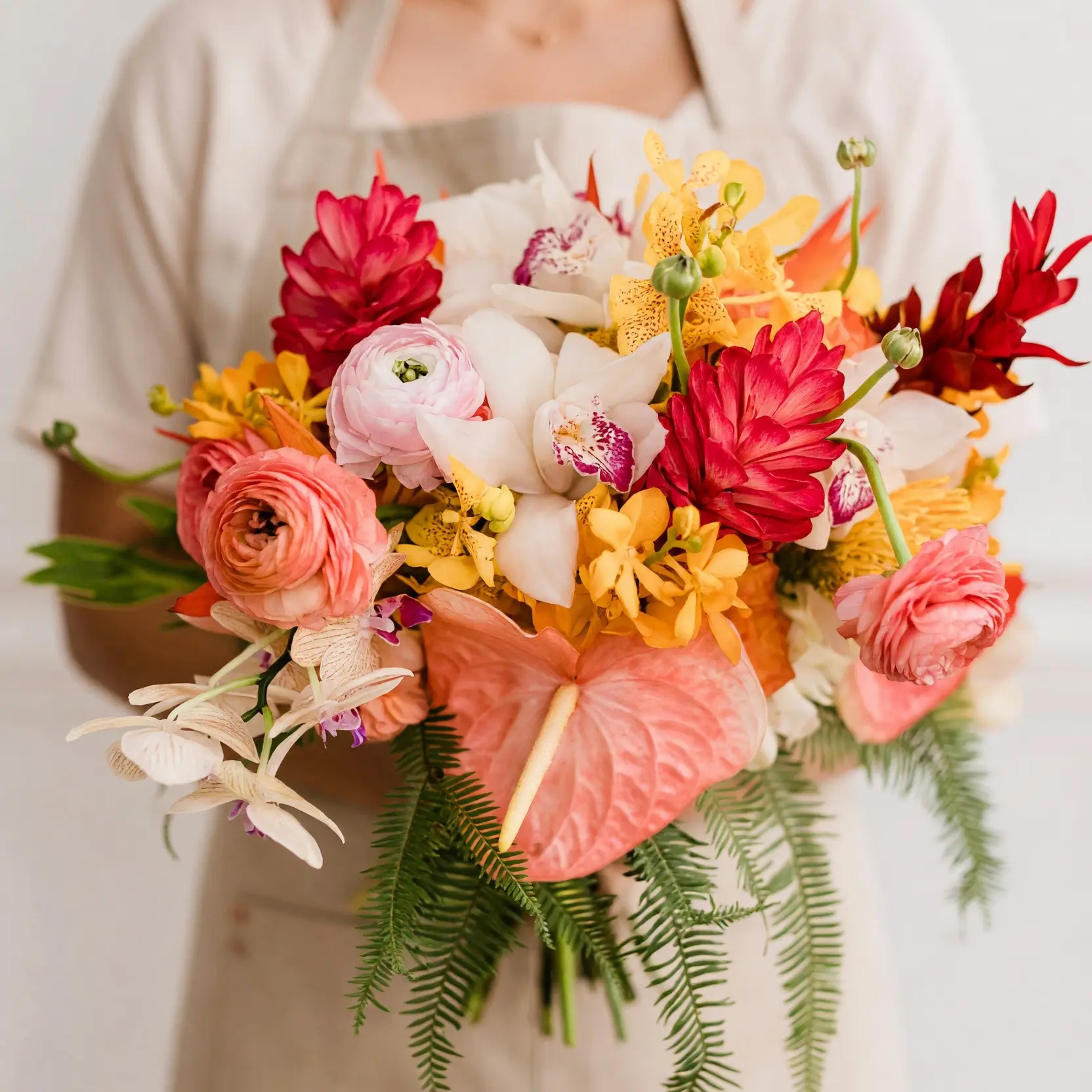
Tropical Wedding Bouquets Coral Ember is a lush celebration of tropical color softened with romantic garden flowers. The composition mixes peach, coral, raspberry, cream, golden yellow, and deep red in a way that feels warm rather than overly bright. A large coral anthurium creates the main sculptural focal point, while orchids, ranunculus, ginger-like tropical blooms, and delicate fern build layers around it. The overall shape feels generous and organic, with flowers extending in several directions instead of forming a perfectly polished sphere.
The coral anthurium immediately gives this bouquet its exotic personality. Its broad heart-shaped surface has a soft salmon-pink finish that looks almost luminous against the surrounding flowers. The pale central spadix adds a clean linear detail, making the bloom feel architectural without becoming severe.
Around the anthurium, warm pink and blush ranunculus introduce a completely different texture. Their tightly layered petals create delicate rounded shapes that soften the bouquet and bring familiar bridal romance into the tropical composition. Some blooms are pale shell pink, while others move toward coral and peach.
The ranunculus also creates a useful bridge between the exotic flowers and more traditional wedding styling. Brides who love tropical flowers but still want the bouquet to feel romantic rather than purely botanical can achieve that balance beautifully with this combination.
White and cream orchids add brightness through the center. Their broad petals appear especially elegant beside stronger red and yellow flowers. Several blooms have patterned raspberry centers, introducing fine detail that becomes noticeable in close-up wedding photographs.
Smaller pale orchids extend from the lower side of the bouquet, giving the arrangement a gently relaxed edge. Rather than appearing perfectly symmetrical, Coral Ember feels gathered and artistic, with different flowers revealing themselves from different angles.
Golden yellow orchids create a sunny layer through the center and upper sections. Their warm tone works naturally with coral and red while adding a lighter accent that prevents the bouquet from becoming too dark.
Deep red tropical blooms create rich focal points around the outer areas. Their layered petals resemble sculptural ginger flowers and help intensify the bouquet’s warm color story. These red flowers are particularly effective because they provide contrast without introducing a completely unrelated shade.
A few orange tropical petals and golden textural flowers add another level of warmth. Instead of relying on green foliage alone for contrast, Coral Ember uses several neighboring colors that transition gradually from cream to yellow, peach, coral, red, and raspberry.
This creates a bouquet that looks abundant but coordinated.
Fern fronds provide the most graceful foliage element. Their narrow repeating leaves fall lightly around the lower portion, introducing movement and a softer botanical texture. The fern keeps the bouquet from feeling too compact and gives the arrangement a subtle garden-inspired finish.
Additional tropical greenery sits behind the flowers, creating depth without dominating the design. The darker leaves help the pale orchids and coral anthurium stand out clearly.
Among bridal flowers bouquets, Coral Ember is especially suitable for a bride who loves strong tropical character but does not want an arrangement made entirely from sharp architectural flowers. The ranunculus and softer orchids keep the composition approachable and romantic.
The bouquet works beautifully with minimalist bridal gowns. Satin, silk, crepe, and mikado provide a clean background that allows the warm tropical palette to become the main decorative feature.
Against lace, Coral Ember feels more romantic and textural. Fine embroidery pairs naturally with layered ranunculus and patterned orchids, while the anthurium provides a smooth contrast that keeps the look fresh.
Pearls complement this bouquet exceptionally well. Their creamy finish echoes the pale flowers while balancing the strong reds and corals. Yellow gold can highlight the golden orchids, while rose gold connects naturally with peach and blush tones.
Bridesmaid bouquets can be simplified using coral ranunculus, pale orchids, and fern. This keeps the wedding party coordinated while reserving the large anthurium and bold tropical flowers for the bride.
Another option is to give attendants mostly cream and peach flowers, allowing the deeper raspberry and red shades to remain exclusive to the bridal bouquet.
Coral Ember is well suited to tropical resorts, destination weddings, botanical gardens, greenhouse venues, elegant outdoor ceremonies, modern estates, beach receptions, and colorful summer celebrations.
Its warm tones can also transition beautifully into late-summer or early-autumn weddings. Coral, red, peach, and gold naturally complement warmer seasonal decor without looking heavy.
For ceremony styling, use the bouquet as inspiration for loose asymmetric floral clusters. Large anthuriums can provide shape, while orchids and red tropical flowers create concentrated areas of color.
Rather than covering an entire wedding structure, allow sections of greenery and open space to remain visible. Tropical flowers often look more sophisticated when their individual shapes are easy to recognize.
Aisle decorations can remain restrained. One orchid stem paired with fern, or a small coral flower cluster tied with neutral ribbon, will reference the bouquet without duplicating its richness.
Reception centerpieces can reinterpret Coral Ember in low arrangements. Coral anthurium, pink ranunculus, white orchids, yellow tropical flowers, and fern can be arranged in shallow ceramic bowls or contemporary glass vessels.
Long dining tables can use smaller bud vases with individual flowers. Alternating coral anthurium, orchids, ranunculus, and textured red flowers creates an elegant rhythm and gives each variety space to shine.
The palette pairs beautifully with ivory, blush, coral, raspberry, burgundy, golden yellow, champagne, and forest green. These colors can appear in stationery, candles, table linens, napkins, or bridesmaid dresses.
For a lighter reception, combine the bouquet with white linen, clear glass, pale wood, and natural woven textures. This keeps the atmosphere fresh and allows the flowers to provide most of the color.
For an evening celebration, deepen the surroundings with burgundy accents, amber glass, dark green textiles, or warm gold candleholders. Coral and yellow flowers can become especially luminous under candlelight.
When discussing bridal flowers bouquets with your florist, describe Coral Ember as tropical, romantic, warm-toned, flower-forward, textural, and softly asymmetric. Mention that the coral anthurium should remain visible as a focal point rather than being hidden inside the arrangement.
Ask for clear variation in flower size and texture. Large smooth anthuriums, layered ranunculus, open orchids, and compact ginger-like blooms should each remain recognizable.
The bouquet should feel full but not compressed. Leaving small spaces between the major flowers will create more dimension and allow the tropical varieties to retain their individual character.
Exact flower varieties may change with seasonal availability. A florist can substitute similar orchids, anthuriums, ranunculus, ginger, or other tropical flowers while preserving the warm coral, red, yellow, cream, and raspberry palette.
The stem handle can be wrapped in ivory, champagne, blush, or muted coral ribbon. A simple finish will complement the colorful flowers better than an elaborate wrap.
Before the ceremony, keep Coral Ember in a shaded indoor location away from direct sun and heat. Tropical flowers can be resilient, but delicate orchids and ranunculus still benefit from careful temperature control.
If your florist recommends hydration, place the cut stems in clean fresh water while keeping the ribbon above the water line. Use a container wide enough that the outer flowers are not pressed against the sides.
Carry the bouquet from the wrapped handle rather than touching the flower faces. Orchid petals and anthuriums can show pressure marks, while ranunculus petals may crease if handled repeatedly.
When the bouquet is not being carried, keep it upright in a supportive vase. Avoid laying it flat because the larger tropical flowers and fern may become compressed.
During outdoor portraits, return Coral Ember to shade during longer breaks. If there is a significant gap between the ceremony and reception, follow the florist’s specific hydration and storage recommendations.
After the wedding, selected orchid petals, fern, ranunculus, ribbon, or sturdier tropical elements may be professionally preserved. Combined with wedding stationery or vows, these pieces can become a colorful botanical keepsake.
Tropical Wedding Bouquets Coral Ember brings together exotic shapes and romantic softness in one expressive arrangement. Coral anthurium adds sculpture, orchids create elegance, ranunculus contributes delicate texture, red tropical flowers provide depth, and fern finishes the bouquet with graceful movement.
Related Products
Recently Viewed Products
Birthday Bouquet Spring Notes: A Cheerful Celebration in Full Bloom
Price range: $99.00 through $229.00

Reviews
There are no reviews yet.