

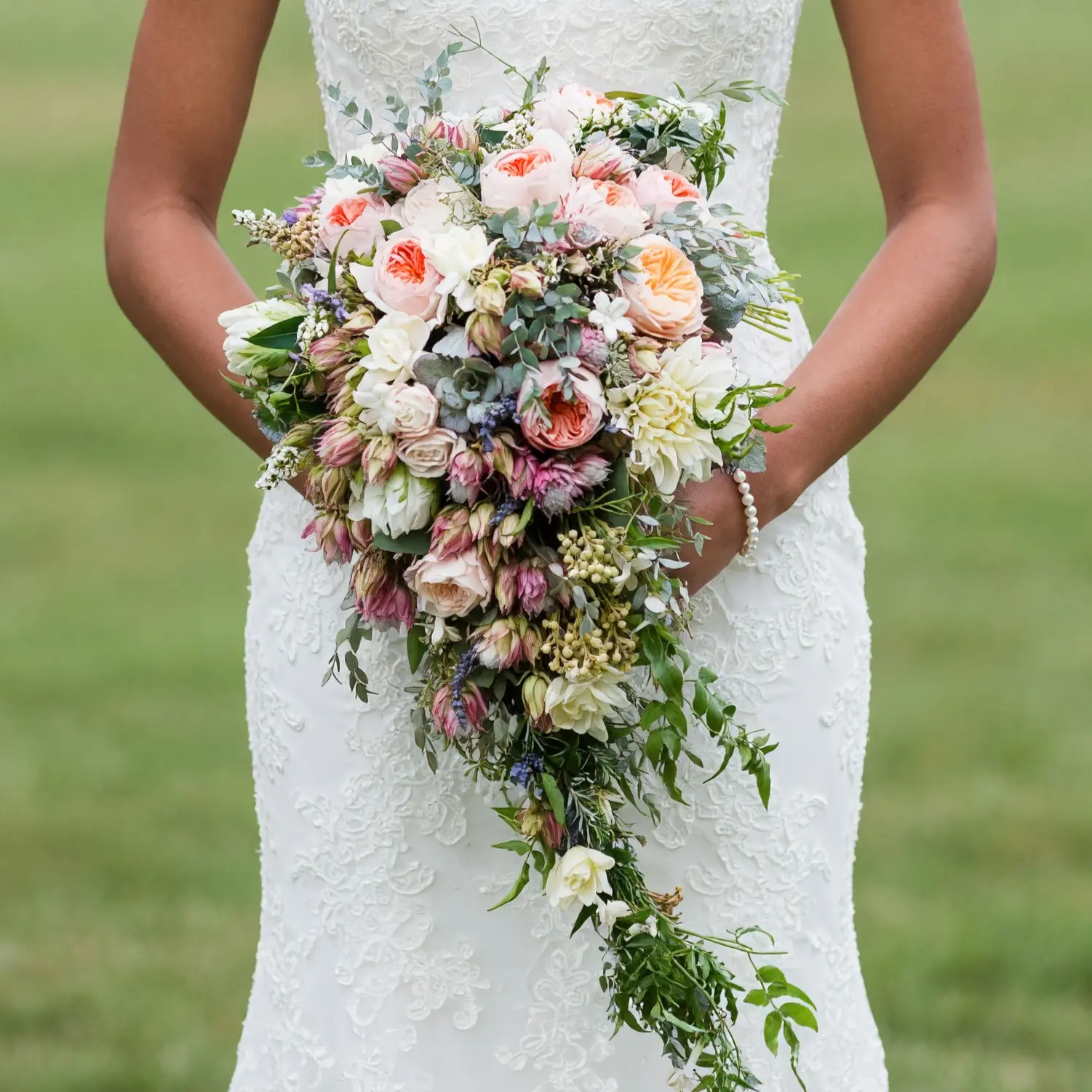
Garden Style Wedding Bouquets Apricot Thicket
Garden Style Wedding Bouquets Apricot Thicket combines apricot and blush roses, ivory garden flowers, dusty mauve buds, subtle blue accents, eucalyptus, and cascading vines. Its layered botanical palette is ideal for garden, estate, vineyard, countryside, summer, and early-autumn weddings.

-
Free shipping on all orders over $30 in the Greater Vancouver Area
popular wedding bouquets feel layered and organic with apricot roses, ivory dahlias, mauve buds, blue accents, and winding greenery.
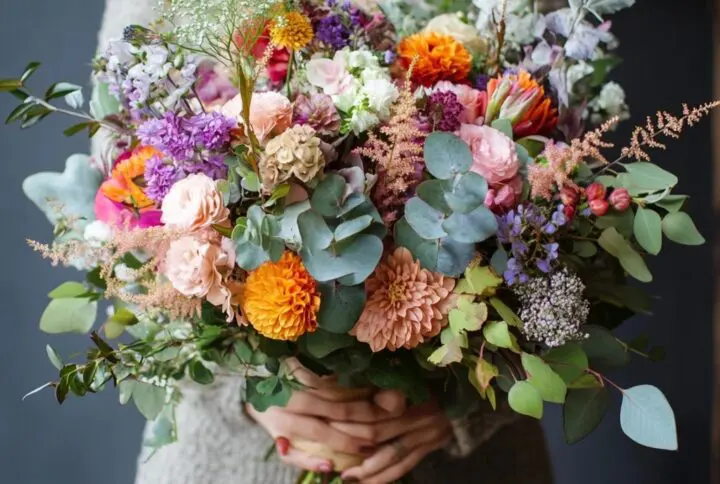
Garden Style Wedding Bouquets Apricot Thicket has the richness of a flower border at the end of summer, when several colors and textures are blooming at once. Soft apricot roses sit beside ivory garden flowers, muted mauve buds, dusty pink petals, tiny blue accents, pale berry-like clusters, eucalyptus, and loose green vines. Rather than separating each variety into neat sections, the bouquet lets everything overlap naturally, creating a wonderfully abundant composition.
The warm roses immediately establish the bouquet’s character. Some appear creamy peach, others lean toward coral, while a few carry a dusty blush tone. Their rounded, layered petals give the arrangement romance, but the surrounding foliage and unusual textural flowers prevent the bouquet from becoming too traditional. The result feels bridal without looking predictable.
Ivory flowers create important moments of brightness. Larger cream blooms sit among the roses and soften the richer pink and mauve shades. Their pale petals also connect the bouquet to the wedding gown, allowing the more colorful flowers to stand out without feeling disconnected from the bridal look.
One of the most interesting details is the collection of dusky pink buds and partially opened flowers through the center and lower half. They give the bouquet the feeling of a living garden where not everything has reached the same stage of bloom. Some petals are fully open, some flowers remain tightly folded, and others sit somewhere between. That natural variation adds tremendous depth.
Muted mauve tones bring another layer to the palette. They are not dramatic purple, but rather softened antique shades that sit beautifully beside peach and ivory. These cooler notes stop Apricot Thicket from becoming overly warm and help the greens appear fresher.
Tiny blue and lavender touches are scattered sparingly throughout the bouquet. They work almost like cool shadows between the warmer flowers. Because the blue is subtle, it rewards close viewing rather than dominating the arrangement. In photographs, these small accents can become especially beautiful beside gray-green eucalyptus.
The greenery has several personalities at once. Rounded eucalyptus leaves introduce a soft silver cast, narrow foliage creates sharper lines, and trailing vines bring movement around the lower section. Some stems extend beyond the flowers, while others weave deeply through the bouquet. This variety makes the greenery feel integrated rather than decorative.
Apricot Thicket is technically a cascading bouquet, but its shape is more relaxed than a classic formal cascade. The floral body remains full and lush near the bride’s hands, then gradually narrows into flowers, foliage, buds, and vines. The lower section keeps enough floral detail to feel connected to the top, yet becomes visibly lighter as it descends.
That transition is especially flattering against a fitted wedding dress. The upper flowers create a romantic focal area while the cascade draws the eye downward along the gown. Lace dresses work beautifully because the small buds, leaves, and branching stems echo embroidered floral patterns. Against satin or crepe, the bouquet appears more sculptural and editorial.
For brides browsing popular wedding bouquets, Apricot Thicket offers an appealing middle ground between classic rose arrangements and more unconventional botanical designs. Roses keep the bouquet familiar, while mauve textures, blue details, eucalyptus, and loose trailing greenery introduce enough personality to make it distinctive.
The bouquet would be particularly suited to garden estates, vineyards, countryside venues, outdoor summer ceremonies, greenhouse weddings, and early-autumn celebrations. Its combination of peach, blush, ivory, mauve, blue, and green can respond beautifully to natural landscapes and warm evening light.
Bridesmaid flowers can be simplified without losing the connection. Smaller arrangements might feature apricot roses, ivory blooms, and eucalyptus with only a touch of mauve. Keeping the longer vines and unusual buds exclusive to the bride allows her bouquet to remain visually richer while preserving a coordinated wedding party.
Another option is to divide the palette between attendants. One bridesmaid could carry mostly peach and ivory, another blush and mauve, and another ivory with blue accents. Repeating the same greenery throughout would unite the group while giving each bouquet an individual garden feel.
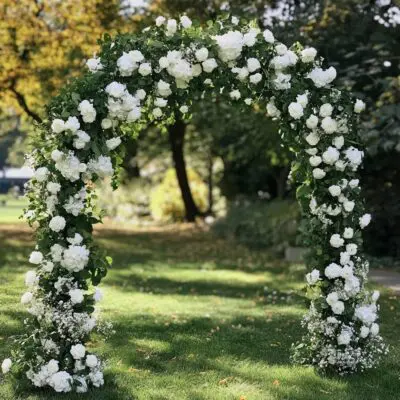
For the ceremony, Apricot Thicket could inspire an asymmetrical arch built from greenery first and flowers second. Clusters of apricot roses and ivory blooms might appear near the center, while mauve buds and delicate blue flowers extend into looser areas. This approach would echo the bouquet’s layered personality without creating a dense wall of flowers.
The aisle can stay much lighter. Small chair arrangements with greenery, one peach flower, and a few delicate buds would provide continuity. Using them only every few rows can make the ceremony feel naturally decorated rather than heavily styled.
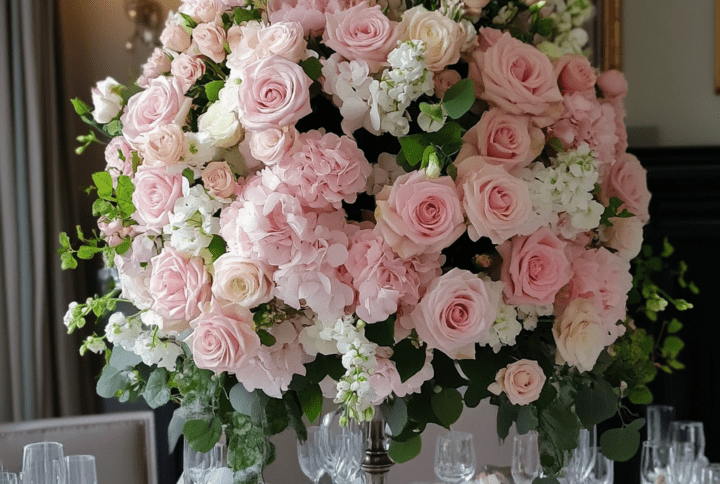
Reception tables offer another interpretation. Low garden arrangements could combine peach roses, cream blooms, muted pink buds, eucalyptus, and tiny blue flowers in ceramic or antique-inspired vessels. For long tables, a mixture of bud vases would let each flower variety remain visible on its own.
The bouquet’s colors also translate beautifully into decor. Dusty peach, soft mauve, warm ivory, faded rose, muted blue, sage, and eucalyptus green all work naturally together. Couples do not need to use every shade elsewhere; selecting two or three can create cohesion while allowing the flowers to remain the most nuanced part of the palette.
This arrangement can move easily between seasons. In late spring, it can lean lighter with more ivory and soft blush. Summer can emphasize peach and fresh green. For early autumn, slightly deeper apricot, mauve, and muted berry tones can create a richer version while keeping the same shape.
Exact flower varieties may change according to availability, and that flexibility actually suits Apricot Thicket. Its identity depends on the relationship between roses, ivory focal flowers, dusty buds, cool accents, eucalyptus, and trailing greenery rather than one particular species. A florist can substitute seasonal blooms while maintaining the same layered mood.
Before the ceremony, keep the bouquet in a cool interior space away from strong sunlight and heat. Large roses and pale flowers can show dehydration quickly, while delicate buds and greenery may soften if exposed to warm conditions for too long.
If the florist recommends water storage, use a clean tall vase with fresh water. Make sure decorative wrapping remains above the water line. Because the bouquet has a trailing section, the container should give the lower stems enough room to hang without becoming crushed against the table.
Carry Apricot Thicket by its wrapped handle rather than by the flowers or greenery. Avoid repeatedly adjusting the lower stems. Their uneven positions are intentional, and excessive handling can bend delicate vines or change the balance of the cascade.
For portraits, hold the bouquet slightly away from the body. This allows the flower layers and trailing greenery to remain visible against the gown. Rotating the arrangement slightly between photographs can also reveal different roses, buds, and foliage, giving the photographer more variation.
When the bouquet is not being used, keep it upright in a supportive vase. Do not place it flat on a chair or table, especially with the cascade underneath. Pressure can flatten the buds, disturb the greenery, and change the silhouette.
During warm outdoor celebrations, return the flowers to shade between longer photography sessions. Never leave the bouquet inside a parked vehicle. If the wedding schedule includes a long pause before the reception, follow the florist’s specific recommendations about hydration.
After the wedding, Apricot Thicket offers many preservation possibilities. Roses and smaller flowers can be pressed, eucalyptus can dry attractively, and selected buds or leaves can become part of framed botanical artwork. A small preserved grouping alongside ribbon or wedding stationery can capture the bouquet’s layered character beautifully.
Garden Style Wedding Bouquets Apricot Thicket is generous without becoming formal and colorful without becoming loud. Apricot roses bring warmth, ivory flowers add softness, mauve buds create depth, blue accents add surprise, and winding greenery gives the entire bouquet a naturally cascading finish.
Related Products
Recently Viewed Products
Birthday Bouquet Spring Notes: A Cheerful Celebration in Full Bloom
Price range: $99.00 through $229.00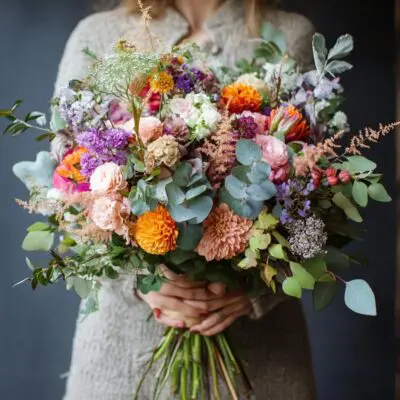

Reviews
There are no reviews yet.