

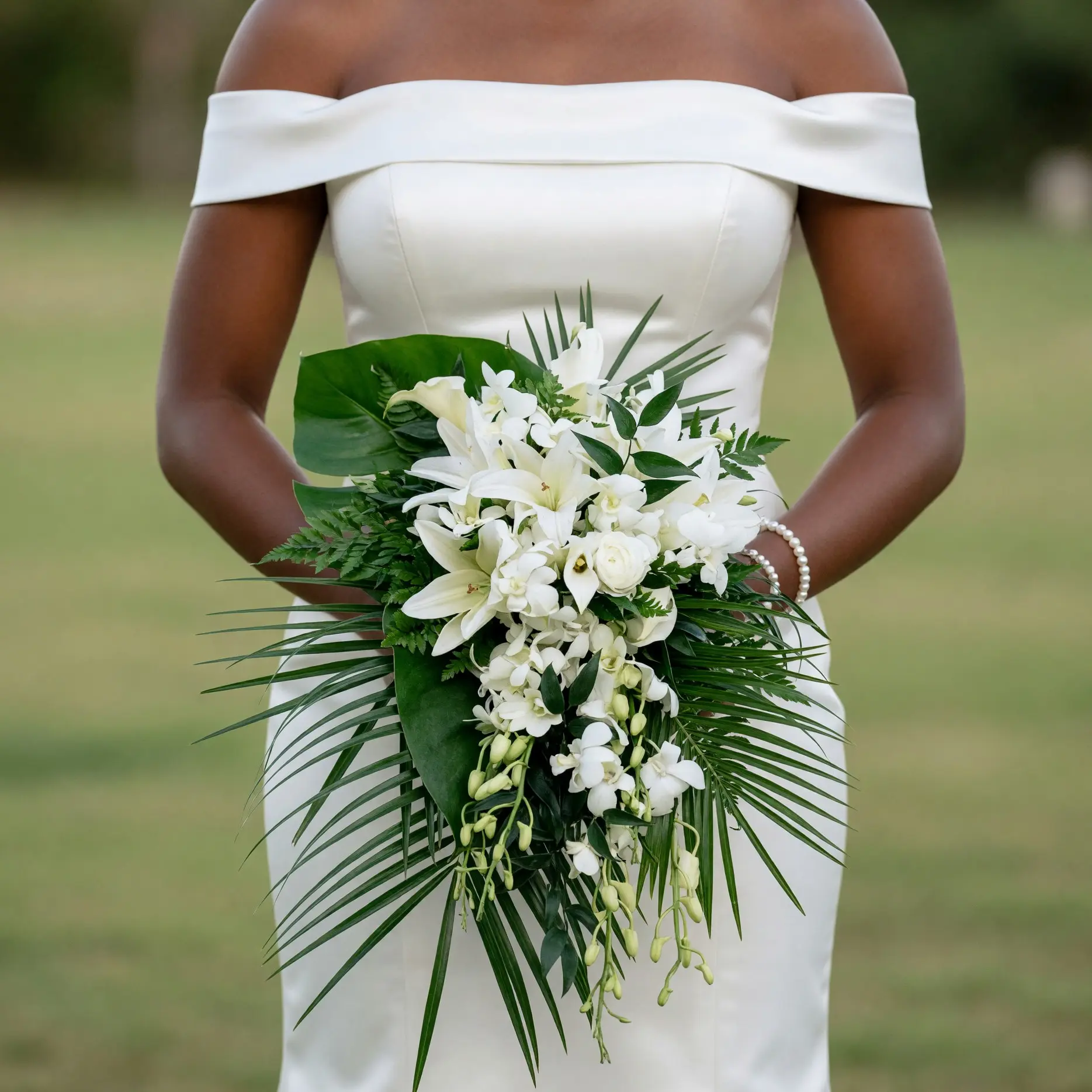
Tropical Wedding Bouquets Ivory Cascade
Tropical Wedding Bouquets Ivory Cascade combines white lilies, flowing orchid stems, ivory roses, palms, fern, and glossy tropical foliage. Its elegant waterfall silhouette is ideal for destination, resort, botanical garden, greenhouse, beach, minimalist, and contemporary weddings.

-
Free shipping on all orders over $30 in the Greater Vancouver Area
popular wedding bouquets become elegantly tropical with white orchids, lilies, roses, cascading blooms, palm fronds, and glossy greenery.
Tropical Wedding Bouquets Ivory Cascade is designed around movement rather than color. The arrangement uses a refined white-and-green palette, but its combination of flower shapes, layered foliage, and flowing orchid stems gives it a dramatic presence. White lilies form open star-shaped focal points, orchids spill downward through the center, compact roses add softness, and tropical leaves create a broad botanical frame. The result feels fresh, luxurious, and distinctly tropical while remaining wonderfully bridal.
The white lilies immediately draw attention near the upper half of the bouquet. Their open petals create bright points against the surrounding greenery, while their elongated shapes introduce a natural sense of direction. They make the arrangement feel airy despite the generous amount of foliage.
White orchids provide the bouquet’s graceful cascading movement. Several stems descend from the floral center, carrying open blossoms and pale green buds toward the lower edge. This creates the classic waterfall effect associated with formal cascading bridal bouquets, but the tropical foliage gives the silhouette a fresher, more contemporary personality.
Rather than forming one heavy floral tail, the orchid stems fall at slightly different lengths. This uneven rhythm keeps the cascade natural and allows individual blossoms to remain visible. Buds at the ends of the stems also introduce subtle variation in texture and color.
Small ivory roses appear between the larger lilies and orchids. Their rounded layered petals create a softer bridal note and help transition between the bold tropical elements. Roses also give the bouquet enough familiar romance to complement traditional wedding styling.
The bouquet’s greenery is just as important as the flowers. Long palm fronds stretch outward and downward, forming elegant dark lines around the white blooms. Their narrow leaflets produce movement while preventing the arrangement from looking too dense.
Broad glossy leaves appear behind the central flowers and act almost like botanical panels. Their smooth surfaces create depth and provide a strong dark background that makes the white flowers appear cleaner and brighter.
Fern fronds introduce finer detail between the larger leaves. Their delicate texture softens the architecture of the palms and gives the bouquet a lush garden character. This mixture of broad, narrow, and finely divided foliage is what gives Ivory Cascade its dimensional tropical look.
One of the most attractive qualities of the bouquet is its asymmetry. The floral center remains balanced in the bride’s hands, yet foliage extends farther in some directions than others. This makes the arrangement feel composed without becoming rigid or overly formal.
Among popular wedding bouquets, an all-white tropical cascade offers a distinctive alternative to pastel garden flowers. It provides strong visual impact through texture and silhouette rather than relying on intense color, making it especially versatile for sophisticated wedding themes.
Ivory Cascade is a natural match for minimalist bridal gowns. Smooth satin, mikado, crepe, or silk creates an elegant background for the white flowers and deep green leaves. Because the bouquet contains so much botanical structure, it adds visual interest without requiring additional color.
An off-the-shoulder dress is particularly complementary. The clean horizontal neckline contrasts beautifully with the downward movement of the orchids and palms, creating an elongated composition from shoulders to bouquet.
The design also works with lace. Against embroidered fabric, the lilies and orchids remain crisp while the tropical foliage introduces contrast. This combination can make a traditional lace gown feel fresher and more contemporary.
Pearl jewelry is a beautiful companion to Ivory Cascade. The soft sheen of pearls echoes the creamy flowers and keeps the overall styling cohesive. Silver, platinum, or white gold can reinforce the cool elegance of the bouquet, while champagne gold introduces a warmer bridal accent.
The bouquet suits destination weddings, tropical resorts, beach ceremonies, botanical gardens, greenhouse venues, modern hotels, elegant estates, and contemporary outdoor celebrations. Its monochromatic flowers allow it to adapt easily to formal or relaxed settings.
Bridesmaid bouquets can be simplified into smaller white-and-green arrangements using one lily, a short orchid stem, and palm foliage. This creates continuity without repeating the full cascade.
Another option is to give attendants compact white rose and greenery bouquets, reserving the long orchids and tropical leaves exclusively for the bride. This makes Ivory Cascade immediately recognizable as the main bridal arrangement in group photographs.
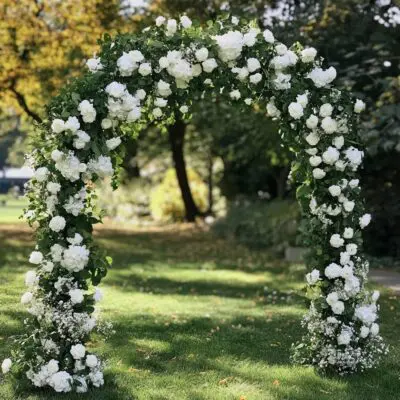
For ceremony styling, the bouquet can inspire botanical installations built around large tropical foliage. Palm leaves, fern, and glossy greens can create an asymmetric structure, while clusters of lilies and orchids provide luminous white focal points.
Instead of covering an entire arch with flowers, leave visible sections of foliage. The contrast between dark greenery and white flowers will create a cleaner and more modern effect.
Aisle arrangements can stay simple. A few white orchids paired with palm or fern would echo the bouquet beautifully without making the ceremony overly decorated.
Reception centerpieces can interpret Ivory Cascade in lower forms. White lilies, roses, orchids, and tropical greenery arranged in ceramic bowls or low glass vessels would maintain the botanical character while keeping tables comfortable for conversation.
For long tables, individual orchid stems, white roses, and small tropical leaves can be placed in narrow bud vases. Repeating several varieties rather than one identical centerpiece will create a relaxed but polished rhythm.
The palette pairs naturally with white, ivory, cream, forest green, sage, champagne, black, silver, and muted gold. Couples who prefer a modern destination aesthetic can combine the flowers with white linen, clear glass, pale wood, and subtle natural textures.
For an evening reception, use deeper green table textiles, black candleholders, smoked glass, or brushed gold. These darker accents will emphasize the brightness of the white flowers and create a sophisticated contrast.
Ivory Cascade is also highly photogenic. The broad palm fronds create clear lines around the bouquet, while white orchids remain visible in both close-up and full-length portraits. The cascading shape photographs especially well from slightly angled positions where the movement of the flowers can be seen.
Seasonal availability may affect the exact orchid or lily varieties used. A florist can substitute related white orchids, calla lilies, roses, or tropical foliage while preserving the essential waterfall silhouette and monochromatic palette.
When discussing popular wedding bouquets with your florist, describe Ivory Cascade as tropical, monochromatic, flowing, elegant, foliage-rich, and softly asymmetric. Mention that you want the white flowers to remain clearly visible rather than being buried inside the greenery.
Ask for a visible cascade instead of a tightly compact shape. The orchids should fall naturally below the center, while palm leaves can extend outward to create width and movement.
The stem handle should remain comfortable and neatly wrapped. White, ivory, champagne, or pale sage ribbon will complement the bouquet without distracting from its botanical structure.
Before the ceremony, keep Ivory Cascade in a shaded indoor location with a stable temperature. White flowers can show bruising or dehydration more easily than darker varieties, so unnecessary handling should be avoided.
If your florist recommends hydration, place the stems in clean fresh water while keeping the ribbon above the water line. Choose a tall, supportive vase that allows the cascading orchids to hang freely without resting on a hard surface.
Carry the bouquet from the wrapped stems rather than from the foliage or orchid sprays. Orchid petals can bruise, and long stems may bend if repeatedly repositioned.
When setting the bouquet down, keep it upright whenever possible. Avoid laying it flat on a chair or table, as pressure can flatten the palm foliage and damage the cascading flowers.
During outdoor photography, return the bouquet to shade during longer breaks. If the ceremony and reception are separated by several hours, follow the florist’s advice for hydration and storage.
After the wedding, individual orchid petals, fern, palm sections, or ribbon may be professionally preserved. A framed botanical arrangement using selected pieces of the bouquet can become an elegant reminder of the wedding day.
Tropical Wedding Bouquets Ivory Cascade combines classic bridal white with the movement and texture of tropical botanicals. Lilies create brightness, orchids form the flowing cascade, roses add romance, and palms and fern complete the bouquet with lush architectural greenery.
Related Products
Recently Viewed Products




Birthday Bouquet Spring Notes: A Cheerful Celebration in Full Bloom
Price range: $99.00 through $229.00

Reviews
There are no reviews yet.